In Mauritius, CANA leaders from Mauritius, Madagascar, the Seychelles, and Réunion gathered for a week of group work, prayer, discussion, and—above all—dancing!
The goal: to develop a model for the CANA mission tailored to the realities of the mission in these four countries.
Marie Bourbonnais, a consecrated sister in the Chemin Neuf community and director of CANA International, explains what the couples experienced as they shared their cultures.
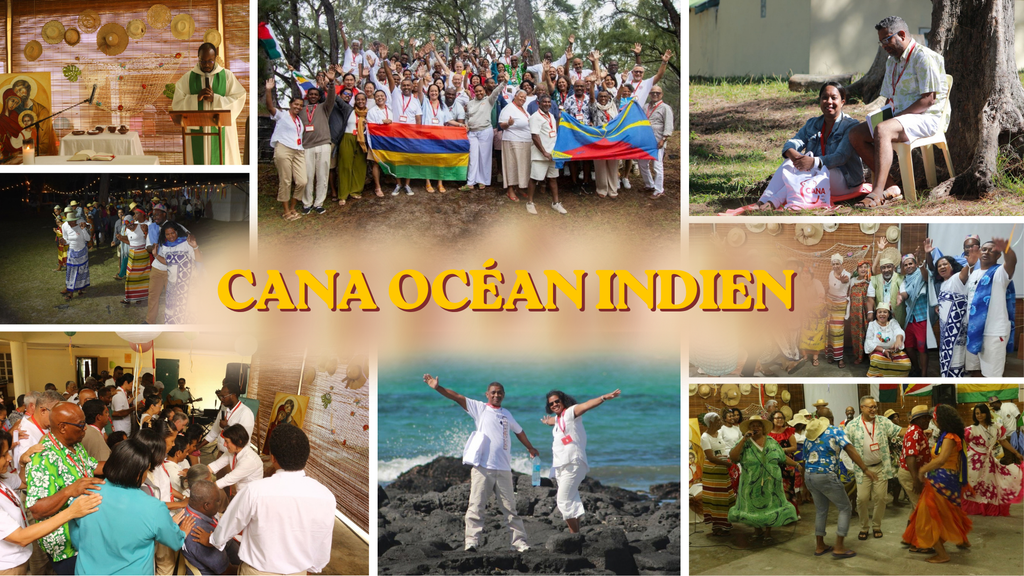
There were nearly 100 of us attending our CANA Indian Ocean gathering in Mauritius: 7 couples from Madagascar; 2 from the Seychelles; 9 from Réunion , including 3 who are in ministry; and 22 Mauritians, including 10 who are in ministry. Also in attendance were the Provincial Superior of the Indian Ocean and the community leaders from each country.
The arrival of the seven couples from Madagascar filled the Community in Madagascar with hope: with almost all of them here in Nazareth, we can sense a new generation emerging—it’s wonderful. They were very grateful to be among us, and most of them went out of their way to generously contribute to the costs of their stay.
The presence of the two couples from the Seychelles also gave us hope. Joseph & Chrysta, the new CANA leaders since February 2026, were there, and they face the challenge of reviving CANA in the Seychelles.
We began by listening to the questions and concerns raised by everyone. From there, we established seven working committees:
- Visibility and Communication of CANA’s Mission
- Attracting the Next Generation to CANA
- The Role of Children at CANA
- The Relevance of CANA’s Teaching Methods and Tools
- Training Needs for Core Members, Servants, and Fraternity Leaders
- The Stages of Growth for a Couple Committed to CANA
- Adapting CANA to Our Logistical and Financial Constraints
The countries were happy to work together, and the follow-up discussions were generally constructive. At the same time, the countries had prepared an overview of their islands and the challenges facing couples and families at the societal level. This allowed us to welcome one another with our different realities. At the end of the week, I gave another an overview of the CANA mission and its challenges, which led us to introduce the CANA Year. Following that, the countries had a productive time working together with their CCN country managers : It was an opportunity for them to reflect on everything they had heard and to consider possible directions for the CANA mission in their own country.
At the core, we were able to rediscover the right balance between listening to the realities of each country and the need to speak with one voice to embrace a shared vision and direction for the mission.
Amid all this work, times of prayer were precious (personal prayer, Masses, adoration, and confessions…), the work of reconciliation centered on our histories (a service for the unity of peoples, the “Indian Ocean” reconciliation…), the celebration of our cultural heritage (a cultural evening with booths featuring traditional games and dances, Mass led by different countries, a festival in traditional dress…), not to mention a worship service on the beach and a few breaks for swimming!
Ultimately, this CANA Indian Ocean gathering was an opportunity to convey the essence of the Chemin Neuf Community: unity among peoples, synodality, diversity of states of life, formation, reconciliation… It would be great if we didn’t have to wait another five years to experience such a gathering together again!