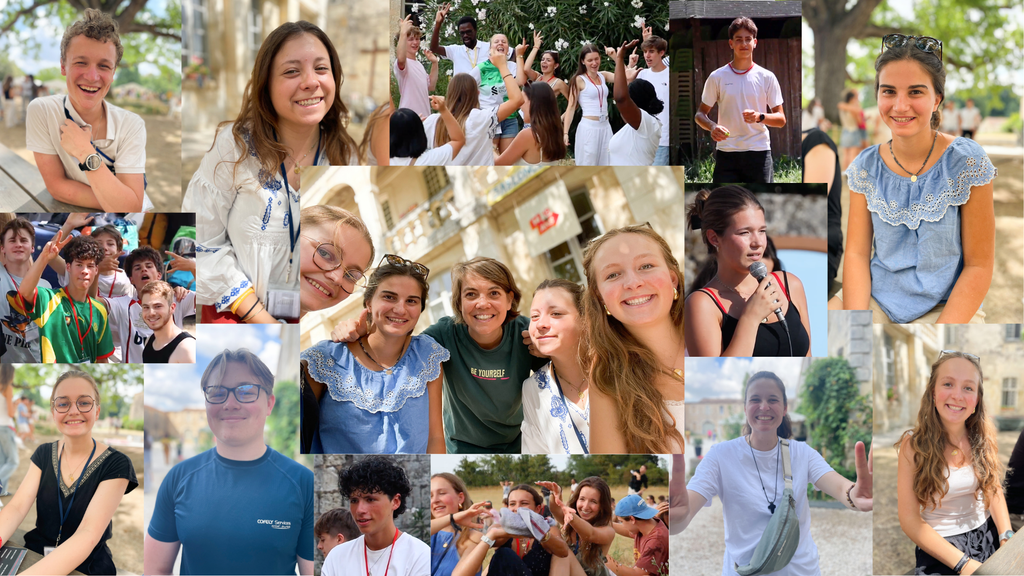
Under the American black walnut tree in the heart ofSablonceaux Abbey (Charente-Maritime), the five summer sessions for teens ages 14 to 18 took place. 251 young people took part in the various camps organized by the Chemin Neuf Community in July.
On the agenda: a traveling camp, a street evangelism performance, a week of sports and challenges, a week for high school students who want to serve others, and finally, the Sabooost Festival!
Laure Delpech, a consecrated sister in the Chemin Neuf Community and the coordinator of this summer’s camps, shares her reflections with us.
In recent years, in our ministry with teenagers, we’ve been struck by the central role that emotions and feelings play in their spiritual lives—a reality that sometimes comes through very strongly. Increasingly, for them as well, life is moving faster, and external demands are drawing them away from a certain inner life. It’s becoming difficult to tune in to what makes less noise—to what remains hidden at first glance.
To feel as though you are having an experience with God, you need something that appeals to your emotions. Yet the Lord’s work and His presence are often subtle.
Our task, then, has been to shift our perspective: to teach young people to look where they would not naturally look, to take a fresh look, and to identify what endures—particularly through learning the spiritual exercises of St. Ignatius.
Our Ignatian spirituality is a true treasure for young people today. Saint Ignatius, too, recognized the importance of interior movements in the spiritual life. What he offers these young people is the ability to discern with greater subtlety what is the work of the Holy Spirit within them, and what is merely a passing distraction that will leave no lasting impression.
Young people are drawn to praise—a form of prayer that brings them immediate satisfaction—in part because it is experienced together with others, in community, something that is particularly important to teenagers. They are less inclined to seek out times of personal prayer, alone before the Word of God, which seems more difficult and arid to them.
We have come to realize our responsibility, in our mission, not to neglect one for the other. We need both in order to listen to the Lord, and that is what we offer them.
In the long run, this ability to listen, these tools for discernment, this skill of reflecting on one’s experiences, and this familiarity with “the gentle breeze”—these are perhaps what young people need most. Above all, these are things they won’t always find elsewhere.
Ultimately, needs and desires are not always the same. In our role as educators, we must be attentive to both.
Laure Delpech