Welcoming visitors to Hautecombe is both a responsibility and a wonderful opportunity for the mission. Here’s a brief historical overview of the abbey’s tradition of hospitality!
Some background information and trends in visitor reception
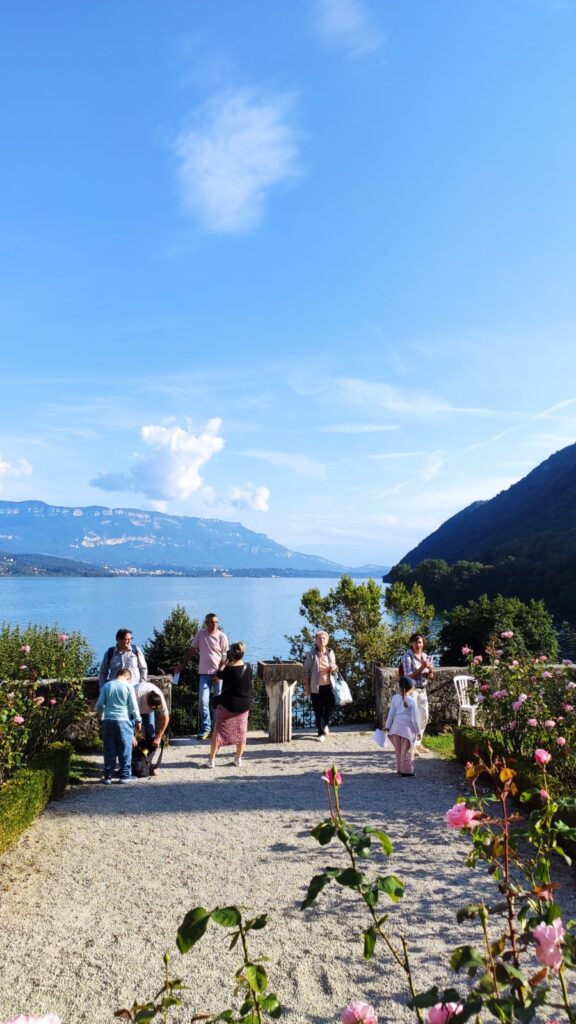
Built in the 12th century to allow monks—who had become Cistercians—to pray in seclusion from the world, Hautecombe Abbey was established on an inhospitable, nearly inaccessible rocky outcrop. The poor, difficult-to-cultivate land, surrounded by a dense forest climbing up a steep mountain, was infested with bandits. People mainly reached it by boat, across a capricious lake where navigation could be dangerous.
Yet, very quickly, Hautecombe became the spiritual center for the House of Savoy. This dynasty reigned for over a millennium over a territory straddling the Alps, stretching from the County of Nice to Geneva, through Piedmont, Sardinia, and Sicily…
They would visit Hautecombe regularly with their court and were buried there upon their deaths.
In the 14th century, the abbey was a major economic power, with holdings extending as far as the Dauphiné and the Lyonnais.
However, due to weathering and a lack of maintenance—and having stood vacant between 1792 and 1825—the church fell into ruins within a few years. It was at this point that the first visitors began to make their way to the abandoned abbey, including Lamartine, who found the church’s ruins romantic.
However, the abbey was quickly revived thanks to the efforts of the King of Sardinia, a descendant of the princes buried there. He encouraged the return of the Cistercian monks in 1826 and undertook a complete renovation of the church.
Elevated and reinforced in its role as the burial ground of the House of Savoy, the abbey—now a royal abbey—has established itself as a major tourist destination. As early as 1838, visitors were flocking to the site in such numbers that the queen—who lived in Turin but had reserved spacious apartments at the abbey, where she visited once or twice a year—hired a royal guard, whose duties included accompanying visitors through the church.
No sooner had he settled in than he began complaining about how overwhelming the task was: the growing number of visitors made it impossible for him to welcome them properly.
Despite the security presence, it is difficult to reconcile the presence of these numerous visitors—who are “supervised” by the royal household—with the community’s life of prayer. Attempts to reduce the number of visitors in the church (no Mass on days when boats arrive, fewer docking permits) have been in vain.
In 1870, the abbot requested that the royal guard be dismissed and replaced by monks, who thus took on the task of welcoming tourists. Two of them organized tours of the church, one managed the royal apartments, and one ran the small shop that had just opened.
From that time on, local tourism stakeholders incorporated Hautecombe into their activities. The monks’ repeated attempts to limit visitor numbers were all thwarted by economic pressures and the intervention of local elected officials.
When the Cistercian monks left around 1920, the archbishop described the terms of reference for the community that would settle in Hautecombe as follows: “Expenses to be paid for the deceased members of the House of Savoy, pensions to be granted to elderly Cistercian monks, costly maintenance of the buildings, and an estate in need of complete renovation. But the most burdensome task is facilitating tours of the building for visitors. From June to October, there is a constant stream of visitors who must be guided and supervised through the church and the royal apartments. There can be as many as five tours in a single day. Steamboats arrive twice a day, and there are often rowboats that dock, whose crews request a tour. It is a frivolous and very unpleasant atmosphere. This is what one must know before accepting the position.
The Trappists of Tamié, who had at one time considered settling in Hautecombe, decided against it for this reason.
As soon as they arrived in 1922, the Benedictine monks set about improving the facilities for visitors, with the aim of preserving their place of worship. The enclosure was expanded, and a refreshment stand was set up. The dock was moved to the boat barn in 1954.
Booklets were published to guide tourists during their visit to the church, and in 1975, the monks launched the first audio-guided tour. In 1980, an exhibition on monastic life was set up in the barn.
The inn was founded in 1982, on the road leading to the harbor.
These improvements enabled the monks to build harmonious relationships with the many visitors. They employed staff and carried out social work. As a result, they held an important place in the hearts of the local residents. However, as their numbers and influence dwindled, they were no longer able to maintain the site or finance the structural repairs made necessary by the dilapidated condition of the buildings.
The arrival of the Chemin Neuf community in 1992 gave the abbey a new lease on life by welcoming large numbers of young people, hosting the festival, and carrying out various missions. It also made it possible to undertake major restoration work and improve the day-to-day maintenance of the buildings. However, as the community is less involved in local life, it has not truly replaced the monks in the hearts of the residents.
However, today, the resources available to keep Hautecombe running are dwindling: it is the involvement of young people in training, along with that of young volunteers from around the world through the “Workaway” program, that makes it possible to welcome the 80,000 visitors who take the audio-guided tour each year. A constant miracle guided by the Holy Spirit.
Hautecombe is now a major tourist attraction in Savoie.
The pressure on Hautecombe has not lessened. On the contrary, Savoie is a tourist region that has grown significantly thanks to skiing and, to a lesser extent, summer tourism. Adapting to climate change and shifting consumption patterns represent a vital economic challenge for the region. Local governments are attempting to transform the economic model of tourism, and Hautecombe Abbey is a cornerstone of their strategy. Furthermore, it is securing public funds (from the department, the region, and the European Union) for the building’s renovation. A form of “give-and-take” is thus taking shape, generating significant expectations. Tourism service standards are evolving (communication, availability, booking procedures, services, hygiene, etc.), and visitors’ expectations are high (exploring an iconic site that has received extensive media coverage).
The challenge, then, is to showcase the living faith embodied in this place and to share the community’s spirituality while collaborating with the secular organizations with which we have formed a partnership to fund the abbey’s renovation.
Relationships with the public and private sectors of the local tourism ecosystem
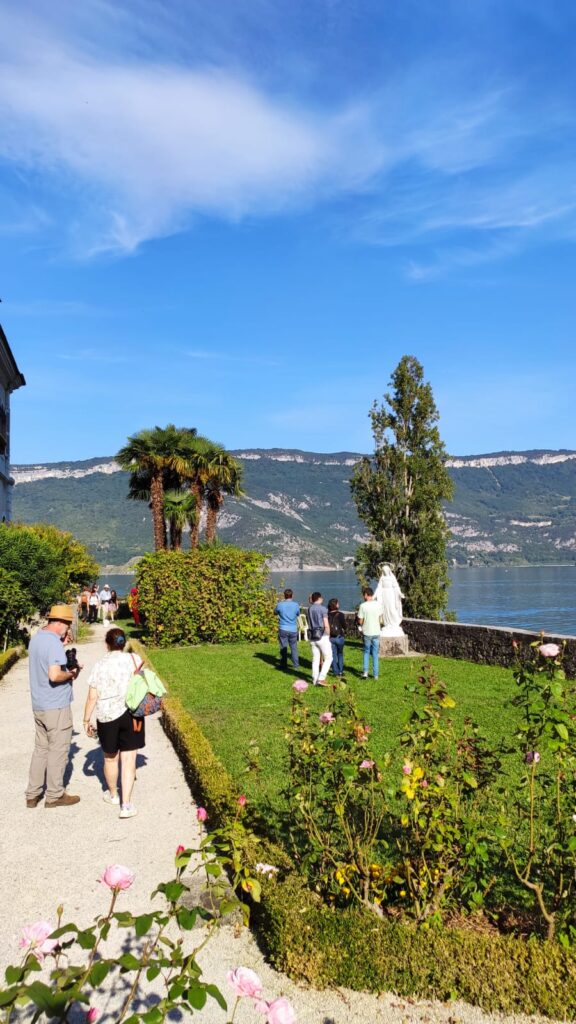
The abbey is the most visited tourist attraction in Savoie (excluding ski resorts). We thus actively contribute to the region’s economic vitality. Hotels, vacation rentals, tour operators, boat companies, and others include Hautecombe in their itineraries. Each year, more than 350 groups come to visit the abbey church. Tourist information offices reach out to us. Press relations officers are increasingly working to raise the department’s profile as a tourist destination and send us influencers, journalists, television crews, and online media representatives several times a year.
Even though this is not the focus of our mission, we must therefore develop our expertise in the areas of heritage (responsibility for a historic monument), history (knowledge of the history of Savoie), and tourism (welcoming visitors and tourists) in order to remain reliable partners.
The Challenges of Our Relationship with the Environment
Carrying on the abbey’s mission of prayer—and continuing to welcome hundreds of young people each year for retreats, the festival , and the Hautecombe Discipleship School— therefore requires a strengthened partnership with our community. Whether with local governments or tourism stakeholders, we seek to build close relationships—but also, and perhaps above all, with Christians in the region, the diocese, and the diverse local community. This is also a way for us to strengthen ourselves as we carry out our mission and welcome visitors.
An Opportunity for the Community
In that sense, this situation is certainly an opportunity for our community. Every year, the Lord sends us more than 100,000 people who are interested, curious, and often available.
These are all opportunities to bear witness to the Gospel—through the care we take in welcoming them and by listening (even if only for a few seconds) to their reality and their stories. So many opportunities for visitors to be touched by our life of prayer. So many opportunities to talk about who we are and how we build unity.
But it’s also an economic opportunity. Although admission fees are extremely low, revenue from tours and the gift shop helps cover the remaining costs after subsidies are applied, and also recognizes the time the community has invested in keeping this place alive.